
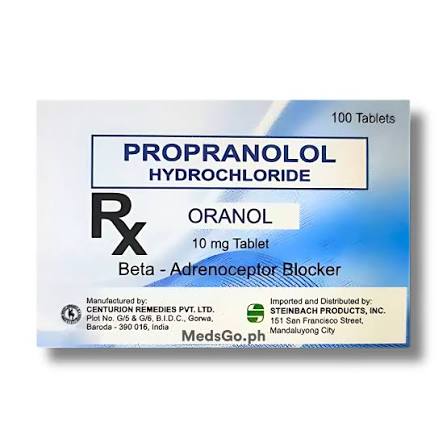
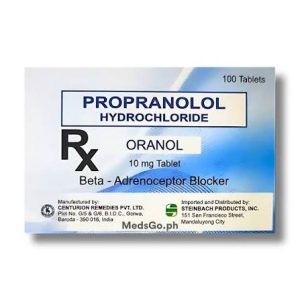
Propranolol (commonly marketed under brand names such as Inderal and InnoPran XL) is a non-selective beta-adrenergic receptor blocker (beta-blocker). Administered orally or intravenously, it works by inhibiting epinephrine (adrenaline) action, reducing heart rate, cardiac workload, and blood pressure, while also stabilizing neuronal hyperexcitability.
Active Ingredient & Mechanism of Action
-
Active Ingredient: Propranolol hydrochloride.
-
Mechanism: Propranolol competitively blocks both $\beta_1$– and $\beta_2$-adrenergic receptors:
-
$\beta_1$-Blockade (Heart & Kidneys): Decreases heart rate, myocardial contractility, cardiac output, and renin secretion from the kidneys, leading to lowered systemic blood pressure and reduced myocardial oxygen demand.
-
$\beta_2$-Blockade (Vascular & Bronchial Smooth Muscle): Inhibits beta-2 receptors in vascular beds and airways, which can cause mild bronchial smooth muscle constriction and peripheral vasoconstriction.
-
Central & Membrane Effects: Exhibits lipophilic properties, allowing it to cross the blood-brain barrier to exert central nervous system effects (helpful for migraine prevention, tremor reduction, and anxiety symptom management).
-
Available Strengths & Dosage Forms
Propranolol is available in several oral and parenteral formulations:
-
Immediate-Release (IR) Tablets: Standard strengths include 10 mg, 20 mg, 40 mg, 60 mg, and 80 mg.
-
Extended-Release (ER/LA) Capsules (e.g., Inderal LA, InnoPran XL): Available in 60 mg, 80 mg, 120 mg, and 160 mg for once-daily coverage.
-
Oral Liquid Solution: 4 mg/mL and 8 mg/mL (as well as Hemangeol 4.28 mg/mL specialized pediatric solution).
-
Injectable Solution (IV): 1 mg/mL vials for acute inpatient emergency treatment.
Clinical Indications
Propranolol is approved and widely used for:
-
Essential Hypertension: Management of high blood pressure, often in combination with other agents.
-
Angina Pectoris: Prevention and long-term management of chest pain due to coronary artery disease.
-
Cardiac Arrhythmias: Control of ventricular and supraventricular tachycardias, atrial fibrillation, and atrial flutter.
-
Migraine Prophylaxis: Prevention of chronic vascular migraine headaches.
-
Essential Tremor: Reduction of involuntary muscular tremors.
-
Hypertrophic Subaortic Stenosis: Symptom management in structural heart muscle thickening.
-
Pheochromocytoma: Adjunctive treatment prior to surgical removal of adrenal tumors.
-
Infantile Hemangioma: Specific specialized pediatric liquid formulation (Hemangeol) for proliferating hemangiomas requiring systemic therapy.
-
Off-Label Uses: Treatment of performance anxiety (“stage fright”), somatic symptoms of panic disorder, and portal hypertension to prevent esophageal variceal bleeding.
Key Pharmacokinetics
-
Absorption: Almost completely absorbed following oral administration, but undergoes extensive first-pass hepatic metabolism (bioavailability is approximately 25%).
-
Onset of Action: Immediate-release forms take effect within 1 to 2 hours; extended-release forms maintain constant levels over 24 hours.
-
Half-Life & Elimination: Short half-life for immediate-release ($\sim 3\text{–}6\text{ hours}$); heavily metabolized by CYP2D6 and CYP1A2 in the liver and excreted in urine.
Administration Guidelines
-
Usage: Immediate-release forms are taken 2 to 4 times daily; extended-release forms are taken once daily.
-
Food Consistency: Food enhances bioavailability; take consistently either always with food or always on an empty stomach.
-
Abrupt Discontinuation Warning: Never stop taking propranolol suddenly. Abrupt withdrawal can precipitate severe rebound hypertension, angina, cardiac arrhythmias, or acute myocardial infarction.
Safety Profile & Considerations
-
Common Side Effects: Bradycardia (slow heart rate), cold extremities, fatigue, dizziness, insomnia/vivid dreams, lightheadedness, and gastrointestinal discomfort.
-
Contraindications:
-
Asthma, severe COPD, or active bronchospasms (due to non-selective $\beta_2$-blockade).
-
Sinus bradycardia, second- or third-degree heart block, or cardiogenic shock.
-
Uncompensated heart failure.
-
-
Key Precautions & Interactions:
-
Diabetes: May mask tachycardia and trembling—the primary warning signs of hypoglycemia.
-
Calcium Channel Blockers (e.g., Diltiazem, Verapamil): Co-administration increases the risk of severe bradycardia and heart block.
-
Antiarrhythmics & CYP Inhibitors: CYP2D6/CYP1A2 inhibitors (e.g., cimetidine, fluoxetine) increase propranolol plasma concentrations.
-
Note: Propranolol is a prescription-only medication. Treatment selection, dosage adjustment, and tapering schedules must be strictly conducted under the supervision of a licensed healthcare professional.




Reviews
There are no reviews yet.