
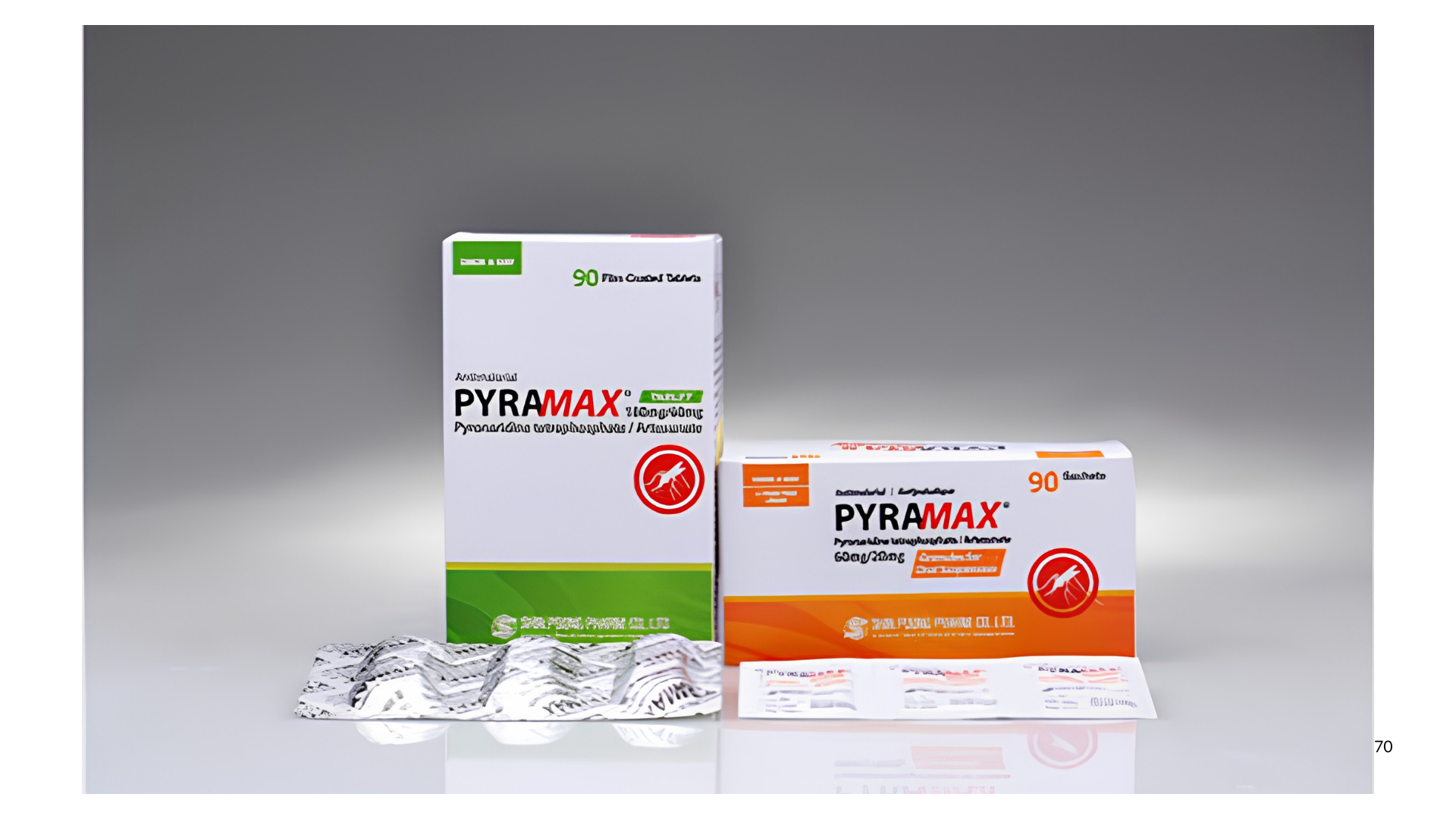
Pyramax (developed by Shin Poong Pharmaceutical and Medicine for Malaria Venture) is a fixed-dose Artemisinin-based Combination Therapy (ACT) containing two active antimalarial agents: pyronaridine tetraphosphate and artesunate.
-
Artesunate: A water-soluble semi-synthetic endoperoxide derivative of artemisinin. It acts rapidly by generating short-lived free radicals that damage essential parasitic proteins and cell membranes, producing swift reduction of parasitemia and fast symptom relief within hours.
-
Pyronaridine: A lipophilic benzonaphthyridine derivative that acts as a long-acting partner drug. It accumulates in the parasite’s food vacuole, inhibiting the conversion of toxic free heme into inert hemozoin and causing parasite cell death, clearing residual parasites and preventing disease relapse.
Unlike many other ACT formulations, Pyramax is unique because its long-acting component (pyronaridine) does not require co-administration with high-fat meals for adequate absorption, simplifying treatment compliance in acute clinical settings.
Primary Medical Indications
Pyramax is indicated for adult and pediatric populations (weighing 5 kg or more) for the treatment of acute, uncomplicated parasitic infections:
-
Uncomplicated Plasmodium falciparum Malaria: First-line curative treatment for acute, uncomplicated malaria caused by P. falciparum.
-
Uncomplicated Plasmodium vivax Malaria: Indicated for the treatment of blood-stage schizonts of P. vivax (radical cure for liver hypnozoites requires adjunct therapy with primaquine or tafenoquine).
-
Multi-Drug Resistant Malaria: Effective against parasite strains showing resistance to older antimalarial monotherapies (such as chloroquine or sulfadoxine-pyrimethamine).
Key Product Specifications & Dosing Forms
| Feature | Specification |
| Active Ingredients | Pyronaridine tetraphosphate + Artesunate |
| Pharmacological Class | Artemisinin-based Combination Therapy (ACT) Antimalarial |
| Available Formulations | Film-coated oral tablets, pediatric oral granules (Pyramax Granules) in sachets |
| Common Strengths |
Tablets: 180 mg pyronaridine / 60 mg artesunate Granules: 60 mg pyronaridine / 20 mg artesunate per sachet |
| Standard Regimen |
Once-daily dosing for 3 consecutive days based on body weight: • 20 kg to <24 kg: 1 tablet once daily for 3 days • 24 kg to <45 kg: 2 tablets once daily for 3 days • 45 kg to <65 kg: 3 tablets once daily for 3 days • $\ge 65\text{ kg}$: 4 tablets once daily for 3 days |
| Administration | Taken orally with water. Can be taken with or without food (does not require dietary fat for bioabsorption) |
Critical Safety Guidelines & Precautions
-
Hepatic Function Monitoring: Pyronaridine can cause transient, asymptomatic elevations in liver transaminases (ALT/AST). Avoid use in patients with severe hepatic impairment or pre-existing liver failure.
-
Re-Dosing Protocol for Vomiting: If vomiting occurs within 30 minutes of taking a dose, a full replacement dose must be administered immediately. If vomiting occurs between 30 minutes and 1 hour, administer half the dose.
-
Once-Daily Dosing Convenience: Unlike 6-dose ACTs (such as artemether/lumefantrine), Pyramax uses a simpler 3-dose, once-daily regimen, which helps improve patient adherence.
-
Not for Severe/Complicated Malaria: Contraindicated as monotherapy for severe or complicated malaria (e.g., cerebral malaria, severe anemia, persistent vomiting). Severe cases require immediate parenteral therapy (e.g., IV artesunate).
-
Prophylaxis Restriction: Pyramax is strictly a therapeutic curative agent and must never be used for malaria prophylaxis.





Reviews
There are no reviews yet.