
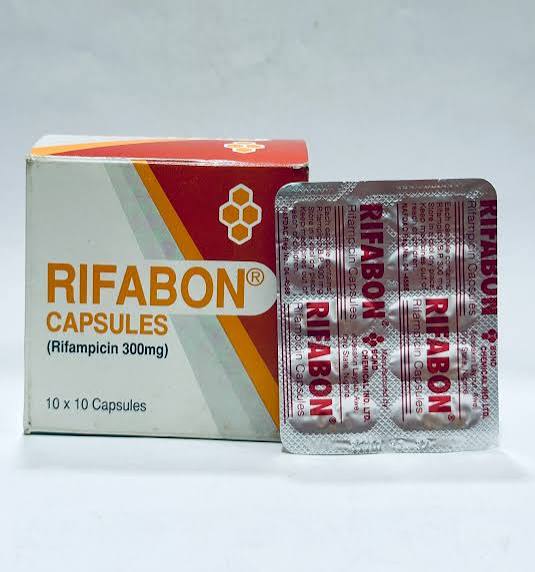
Rifampicin (commonly marketed in various regional markets under brand names such as Rifabon, Rifadin, or Rimactane) is a potent, broad-spectrum antibiotic belonging to the rifamycin drug class. It is best known for its critical role in the combination treatment of tuberculosis (TB) and leprosy, as well as for prophylactic management of serious bacterial exposures.
Active Ingredient & Mechanism of Action
-
Active Ingredient: Rifampicin (also referred to as Rifampin).
-
Mechanism: Rifampicin inhibits bacterial growth by selectively binding to the $\beta$-subunit of bacterial DNA-dependent RNA polymerase.
-
Transcription Inhibition: By binding to this enzyme, it blocks the initiation of RNA transcription and halts bacterial messenger RNA (mRNA) synthesis.
-
Bactericidal Activity: This disruption leads directly to bacterial cell death. Because human RNA polymerase has a distinctly different subunit structure, rifampicin targets bacterial cells while sparing host mammalian RNA synthesis.
-
Dosage Forms & Available Strengths
Rifampicin (Rifabon) is supplied in several oral and parenteral formulations:
-
Oral Capsules / Tablets: Standard individual strengths include 150 mg, 300 mg, and 600 mg.
-
Oral Suspension: Liquid formulations (e.g., 20 mg/mL) designed for pediatric patients or individuals with difficulty swallowing capsules.
-
Intravenous (IV) Injection: Powder for reconstitution (typically 600 mg vials) used in acute, severe inpatient settings where oral administration is impossible.
-
Fixed-Dose Combinations (FDCs): Frequently co-formulated with other first-line anti-TB medications (such as Isoniazid, Pyrazinamide, and Ethambutol) to prevent drug resistance and simplify daily treatment schedules.
Clinical Indications
Rifampicin is indicated for:
-
Tuberculosis (TB): A core component of first-line combination regimens for treating all forms of active Mycobacterium tuberculosis infection.
-
Leprosy (Hansen’s Disease): Used as part of World Health Organization (WHO) multi-drug therapy (MDT) alongside dapsone and clofazimine.
-
Meningococcal Prophylaxis: Short-term administration to clear asymptomatic nasopharyngeal carriage of Neisseria meningitidis in close contacts of infected patients.
-
Haemophilus influenzae Type b (Hib) Prophylaxis: Prevention of invasive Hib disease in close household contacts.
-
Serious Staphylococcal Infections: Used as adjunctive/combination therapy (never as monotherapy) alongside other agents (e.g., vancomycin or flucloxacillin) to treat severe Staphylococcus aureus infections, including prosthetic valve endocarditis or osteomyelitis.
Note: Except for specific short-term prophylaxis regimens, rifampicin must never be used as a single agent (monotherapy) for active infections, as bacteria rapidly develop high-level resistance.
Key Pharmacokinetics
-
Absorption: Well absorbed from the gastrointestinal tract when taken on an empty stomach.
-
Food Effect: Food delays absorption and reduces peak plasma concentrations ($C_{max}$).
-
Distribution: Highly lipophilic; distributes widely throughout body tissues and fluids, including lung tissue, liver, bone, pleural fluid, and cerebrospinal fluid (CSF).
-
Metabolism & Elimination: Metabolized primarily by the liver into an active deacetylated metabolite. It undergoes enterohepatic circulation and is excreted in bile/feces and urine.
-
Half-Life: Approximately 3 to 5 hours, shortening over early weeks of continuous therapy due to auto-induction of hepatic enzymes.
Administration Guidelines
-
Timing: Administered orally on an empty stomach—either 1 hour before or 2 hours after meals—with a full glass of water to ensure maximal absorption.
-
Consistency: Daily compliance and adherence to the full prescribed duration are vital to avoid treatment failure and the emergence of drug-resistant strain variants (MDR-TB).
Safety Profile & Considerations
-
Benign Body Fluid Discoloration (Key Patient Warning): Rifampicin causes a reddish-orange discoloration of body fluids, including urine, sweat, saliva, tears, sputum, and feces. This is harmless, but patients should be warned that soft contact lenses may become permanently stained.
-
Common Side Effects: Gastrointestinal upset (nausea, vomiting, abdominal pain), rash, fever, fatigue, and transient elevations in liver enzymes.
-
Hepatotoxicity: Can cause liver damage, particularly when co-administered with other hepatotoxic drugs like isoniazid or pyrazinamide. Regular monitoring of liver function tests (LFTs) is essential.
-
Potent Enzyme Induction (Major Drug-Drug Interactions): Rifampicin is a potent inducer of hepatic CYP450 enzymes (especially CYP3A4 and CYP2C9) and P-glycoprotein (P-gp). It dramatically accelerates the clearance and lowers the blood concentrations of many concurrent medications, including:
-
Oral Contraceptives: Renders hormonal birth control ineffective; non-hormonal barrier methods must be used.
-
Anticoagulants (e.g., Warfarin, DOACs): Significantly reduces blood-thinning effectiveness.
-
Antiretrovirals (e.g., Protease Inhibitors, Integrase Inhibitors): Alters HIV treatment levels.
-
Antidiabetics, Anticonvulsants, & Immunosuppressants (e.g., Cyclosporine, Tacrolimus): Substantially lowers therapeutic drug levels.
-
-
Contraindications: Severe hypersensitivity to rifamycins or severe active hepatic dysfunction. Concomitant use with specific protease inhibitors or combination antivirals (such as saquinavir/ritonavir) is contraindicated.
Note: Rifampicin (Rifabon) is a strictly regulated prescription antibiotic. Liver function monitoring, evaluation for drug interactions, and regimented dosing must be overseen directly by a qualified healthcare professional.






Reviews
There are no reviews yet.