

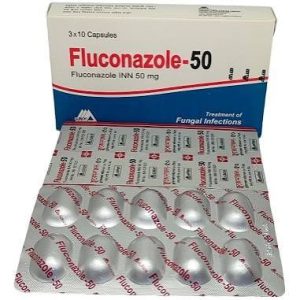
Fluconazole (commonly known by brand names such as Diflucan) is a synthetic triazole antifungal medication. Administered orally or intravenously, it is used to treat and prevent a wide variety of superficial and systemic fungal infections, most notably those caused by Candida and Cryptococcus species.
Active Ingredient & Mechanism of Action
-
Active Ingredient: Fluconazole.
-
Mechanism: Fluconazole is a highly selective inhibitor of the fungal cytochrome P450 enzyme lanosterol 14$\alpha$-demethylase:
-
Inhibition of Ergosterol Synthesis: By blocking this enzyme, fluconazole prevents the conversion of lanosterol to ergosterol, an essential component of the fungal cell membrane.
-
Membrane Disruption: The depletion of ergosterol, along with the accumulation of toxic 14$\alpha$-methyl sterols, alters cell membrane permeability and fluidity, inhibiting fungal cell growth and replication (fungistatic effect).
-
Available Strengths & Dosage Forms
Fluconazole is supplied in several oral and parenteral formulations:
-
Oral Tablets: Standard strengths include 50 mg, 100 mg, 150 mg, and 200 mg.
-
Oral Suspension: Available as 10 mg/mL and 40 mg/mL liquid formulations (often reconstituted from powder) for pediatric patients or individuals with difficulty swallowing pills.
-
Intravenous (IV) Infusion: Ready-to-use solution (2 mg/mL in normal saline or dextrose) for severe or inpatient systemic infections.
Clinical Indications
Fluconazole is indicated for:
-
Vaginal Candidiasis (Vaginal Yeast Infection): Single-dose oral treatment (150 mg) for acute, uncomplicated infections.
-
Oropharyngeal & Esophageal Candidiasis (Thrush): Treatment of mucosal Candida infections in immunocompetent and immunocompromised individuals.
-
Systemic Candidiasis: Treatment of candidemia, disseminated candidiasis, and peritonitis.
-
Cryptococcal Meningitis: Treatment of active cryptococcal meningitis (often following initial induction therapy with amphotericin B) and long-term suppressive therapy to prevent relapse in patients with HIV/AIDS.
-
Antifungal Prophylaxis: Prevention of candidiasis in high-risk patients, such as those undergoing bone marrow transplants, chemotherapy, or advanced immunosuppressive therapy.
Key Pharmacokinetics
-
Absorption: Exceptionally well absorbed following oral administration with an absolute bioavailability exceeding 90%. Absorption is not affected by gastric pH or food intake.
-
Distribution: Highly water-soluble with low plasma protein binding ($\sim 11\text{–}12\%$). Distributes widely throughout all body tissues and fluids, achieving high concentrations in cerebrospinal fluid (CSF), skin, saliva, and vaginal secretions.
-
Elimination & Half-Life: Long elimination half-life of approximately 30 hours in adults, supporting once-daily (or single-dose) administration regimens. Excreted predominantly unchanged through the kidneys into the urine ($\sim 80\%$).
Administration Guidelines
-
Usage: Administered orally or via IV infusion once daily (except for single-dose vaginal candidiasis).
-
Food Consistency: Can be taken with or without food.
-
Renal Adjustment: Because it is cleared primarily by the kidneys, dosage reductions (typically by 50%) are required for patients with moderate to severe renal impairment (creatinine clearance $< 50\text{ mL/min}$).
Safety Profile & Considerations
-
Common Side Effects: Headache, nausea, abdominal pain, diarrhea, dizziness, dyspepsia, and mild skin rash.
-
Hepatic Safety: Can cause transient elevations in liver enzymes. Rare cases of severe hepatoxicity or hepatic failure have been reported, requiring baseline and periodic liver function monitoring during prolonged therapy.
-
Cardiac Risk (QT Prolongation): Can prolong the QT interval on an ECG, carrying a risk of ventricular arrhythmias (including Torsades de Pointes), particularly in patients with structural heart disease, electrolyte imbalances, or those taking other QT-prolonging drugs.
-
Pregnancy Warning: High doses or prolonged exposure during the first trimester carry a risk of congenital birth defects. A single 150 mg dose for vaginal thrush should only be used during pregnancy if clearly needed and advised by a physician.
-
Key Drug Interactions (CYP450 Inhibition): Fluconazole is a potent inhibitor of CYP2C9 and CYP3C19, and a moderate inhibitor of CYP3A4. It significantly elevates blood levels of many concurrent drugs, including:
-
Warfarin / Coumarin Anticoagulants: Increases prothrombin time and bleeding risk.
-
Oral Hypoglycemics (e.g., Sulfonylureas): Elevates blood levels, increasing the risk of hypoglycemia.
-
Phenytoin & Carbamazepine: Increases anticonvulsant toxicity risk.
-
Statins (e.g., Atorvastatin, Simvastatin): Elevates risk of myopathy and rhabdomyolysis.
-
Calcineurin Inhibitors (e.g., Cyclosporine, Tacrolimus): Increases nephrotoxicity risks.
-
Note: Fluconazole is a prescription antifungal medication. Treatment duration, dosage adjustments for renal function, and screening for major drug interactions must be managed under direct healthcare supervision.









Reviews
There are no reviews yet.