
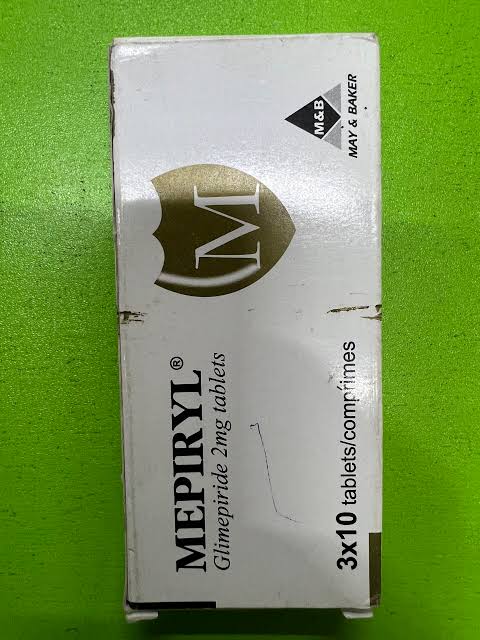
Mepiryl (manufactured by May & Baker) is an oral antihyperglycemic medication containing glimepiride, a potent second- or third-generation sulfonylurea. It works primarily as an insulin secretagogue by binding selectively to sulfonylurea receptors (SUR1) on the plasma membrane of pancreatic beta cells.
This binding blocks ATP-sensitive potassium ($K_{\text{ATP}}$) channels, leading to cell membrane depolarization, opening of voltage-gated calcium channels, calcium influx, and subsequent exocytosis of pre-formed insulin granules into the bloodstream. Because Mepiryl relies on functional pancreatic beta cells, it requires residual endogenous insulin secretion to be clinically effective. Relative to older sulfonylureas, glimepiride dissociates more rapidly from the SUR1 receptor, which translates to a lower risk of severe prolonged hypoglycemia and reduced hyperinsulinemic drive between meals.
Primary Medical Indications
Mepiryl is indicated for adult patients (aged 18 years and older) in the management of metabolic and endocrine conditions:
-
Type 2 Diabetes Mellitus: As an adjunct to diet and exercise to lower elevated blood glucose and reduce HbA1c levels when non-pharmacological interventions alone are insufficient.
-
Monotherapy: For type 2 diabetic patients where metformin is contraindicated or poorly tolerated.
-
Dual & Triple Combination Therapy: Combined with other complementary antidiabetic agents (e.g., metformin, DPP-4 inhibitors, SGLT2 inhibitors, or thiazolidinediones) or basal/bolus insulin when single-agent therapy fails to achieve target blood glucose levels.
Key Product Specifications & Dosing Forms
| Feature | Specification |
| Active Ingredient | Glimepiride |
| Pharmacological Class | Second/Third-generation Sulfonylurea Antidiabetic |
| Available Formulations | Oral uncoated / scored tablets |
| Common Strengths | 1 mg, 2 mg, 3 mg, 4 mg tablets |
| Standard Dosage |
Initial: 1 mg to 2 mg orally once daily with breakfast or the first main meal. Titration: Increased by 1 mg to 2 mg at weekly or bi-weekly intervals based on blood glucose response, up to a maximum recommended dose of 6 mg to 8 mg daily |
| Administration | Must be swallowed whole with liquid immediately before or during breakfast or the first substantial meal of the day |
Critical Safety Guidelines & Precautions
-
Hypoglycemia Risk: As an insulin secretagogue, Mepiryl can cause hypoglycemia (low blood sugar), particularly if meals are skipped or delayed, during unaccustomed strenuous physical exercise, excessive alcohol consumption, or co-administration with other hypoglycemic agents.
-
Must Be Taken with Food: To prevent sudden drops in blood glucose, Mepiryl must always be taken immediately before or during a main meal containing complex carbohydrates.
-
G6PD Deficiency Warning: Treatment with sulfonylureas in patients with glucose-6-phosphate dehydrogenase (G6PD) deficiency can lead to acute hemolytic anemia. Consider non-sulfonylurea alternatives in this population.
-
Renal & Hepatic Impairment: Clearance is impaired in severe renal or hepatic disease, raising the risk of drug accumulation and prolonged hypoglycemia. Start with 1 mg daily and titrate cautiously.
-
Contraindications: Strictly contraindicated in patients with type 1 diabetes mellitus, diabetic ketoacidosis (DKA), diabetic coma/pre-coma, or known hypersensitivity to glimepiride, sulfonylureas, or sulfonamide derivatives.








Reviews
There are no reviews yet.