
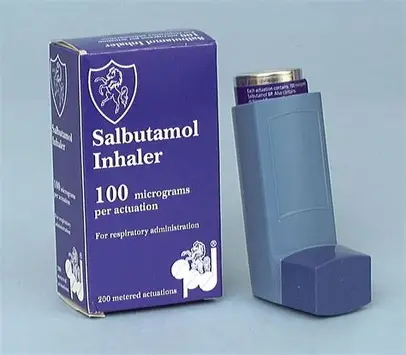
Salbutamol (also known as Albuterol in the United States, and widely recognized under brand names such as Ventolin and ProAir) is a short-acting $\beta_2$-adrenergic receptor agonist (SABA). It acts as a fast-acting bronchodilator to relax airway smooth muscle and rapidly relieve acute breathing difficulty.
Active Ingredient & Mechanism of Action
-
Active Ingredient: Salbutamol sulfate (or Albuterol sulfate).
-
Mechanism:
-
Selective $\beta_2$-Receptor Activation: Salbutamol selectively stimulates $\beta_2$-adrenergic receptors on airway smooth muscle cells.
-
cAMP Accumulation: Activation stimulates adenylate cyclase, increasing intracellular cyclic adenosine monophosphate ($cAMP$).
-
Bronchodilator Action: Elevated $cAMP$ levels activate protein kinase A, leading to smooth muscle relaxation, bronchial dilation, decreased airway resistance, and mild inhibition of inflammatory mediator release from mast cells.
-
Dosage Forms & Available Formulations
Salbutamol is produced in multiple administrative formats:
-
Pressurized Metered-Dose Inhaler (pMDI): Standard 100 mcg per puff (or 90 mcg base delivery in the US), typically packaged as 200 actuations.
-
Dry Powder Inhaler (DPI / Accuhaler / Diskhaler): 200 mcg per dose for inhalation.
-
Nebulizer Solution: 2.5 mg / 2.5 mL or 5 mg / 2.5 mL unit-dose ampoules used with a jet or ultrasonic nebulizer in acute care or clinical settings.
-
Oral Syrup & Tablets: 2 mg / 5 mL syrup or 2 mg / 4 mg oral tablets (less commonly used due to higher systemic side effects compared to inhaled forms).
-
Intravenous (IV) Injection: Used in hospital emergency settings for severe status asthmaticus or as a tocolytic (to inhibit premature labor).
Clinical Indications
-
Acute Bronchospasm Relief: Rapid treatment of acute bronchospasm associated with Asthma and Chronic Obstructive Pulmonary Disease (COPD).
-
Exercise-Induced Bronchospasm (EIB): Prophylactic prevention of exercise-triggered asthma attacks when inhaled shortly before physical activity.
-
Severe Hyperkalemia (Off-Label / Clinical Use): Nebulized high-dose salbutamol drives excess potassium from extracellular fluid back into intracellular compartments.
Key Pharmacokinetics
-
Onset of Action: Very rapid when inhaled—effects begin within 3 to 5 minutes and peak within 30 to 60 minutes.
-
Duration of Effect: Short-acting duration of 3 to 6 hours.
-
Metabolism & Elimination: Metabolized primarily in the liver to an inactive sulfate conjugate. Excreted mainly by the kidneys in urine ($\sim 80\%$) within 72 hours.
Administration Guidelines
-
Inhaler Technique:
-
Shake the pMDI well before use.
-
Exhale completely, place the mouthpiece securely between lips, and begin inhaling slowly and deeply while pressing down on the canister once.
-
Hold breath for 10 seconds (or as long as comfortable) to allow drug deposition in deep pulmonary airways.
-
Use of a valved holding chamber (spacer) is strongly recommended to improve drug delivery to the lungs and minimize oral deposition.
-
-
Typical Relief Dosing (Adults & Children):
-
Acute Symptoms: 1 to 2 puffs inhaled every 4 to 6 hours as needed.
-
Prevention of Exercise-Induced Asthma: 2 puffs inhaled 10 to 15 minutes prior to exercise.
-
-
Over-Reliance Warning: Salbutamol is a “rescue” medication that treats symptoms, not the underlying airway inflammation. Needing a rescue inhaler more than 2 days a week indicates poor asthma control and requires evaluation for daily anti-inflammatory controller therapy (such as inhaled corticosteroids).
Safety Profile & Considerations
-
Common Side Effects (Systemic $\beta_2$-Stimulation):
-
Cardiovascular: Tachycardia (fast heartbeat), palpitations, and mild transient blood pressure changes.
-
Neuromuscular: Skeletal muscle tremors (especially fine hand tremors) and inner restlessness/nervousness.
-
Metabolic: Transient hypokalemia (low serum potassium) and minor elevations in blood glucose at high or frequent doses.
-
-
Precautions & Warnings:
-
Paradoxical Bronchospasm: Uncommonly, inhaled formulations can trigger sudden, life-threatening bronchospasm immediately after dosing. Discontinue use immediately if this occurs.
-
Cardiovascular Disease: Use with caution in patients with underlying ischemic heart disease, arrhythmias, or severe hypertension.
-
-
Key Drug Interactions:
-
Non-Selective Beta-Blockers (e.g., Propranolol): Block the action of salbutamol, preventing bronchodilation and potentially triggering severe asthma attacks.
-
Diuretics (Loop/Thiazide): Co-administration with potassium-wasting diuretics can compound the risk of hypokalemia.
-
Monoamine Oxidase Inhibitors (MAOIs) & Tricyclic Antidepressants (TCAs): Can potentiate cardiovascular side effects.
-
Note: Salbutamol is an essential short-acting bronchodilator. Frequency of use, inhaler administration technique, and long-term asthma action planning should be reviewed with a healthcare provider.







Reviews
There are no reviews yet.