
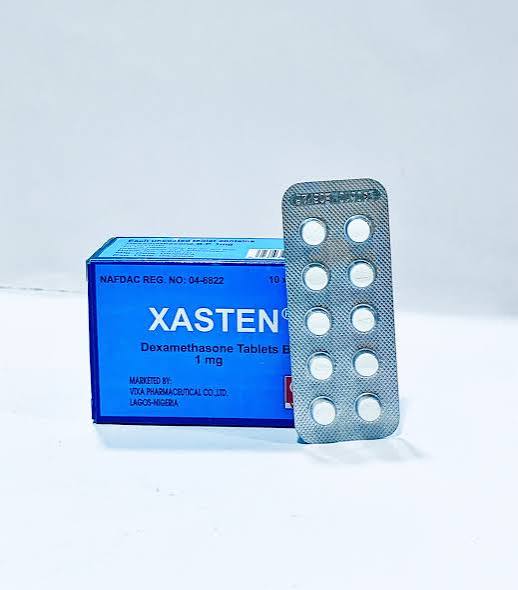
Xasten is a brand name for Dexamethasone (marketed by Vixa Pharmaceutical), a long-acting, highly potent fluorinated corticosteroid. It serves as a powerful anti-inflammatory and immunosuppressive agent, with an anti-inflammatory potency approximately 25 to 30 times greater than hydrocortisone and 5 to 7 times greater than prednisone.
Active Ingredient & Mechanism of Action
-
Active Ingredient: Dexamethasone.
-
Mechanism: Dexamethasone crosses cell membranes to bind with intracellular glucocorticoid receptors. This complex translocates into the cell nucleus to:
-
Inhibit Inflammatory Cascades: Suppress the transcription of pro-inflammatory cytokines, chemokines, and inflammatory enzymes (such as COX-2).
-
Inhibit Immune Cell Activity: Reduce white blood cell recruitment, capillary permeability, and vasodilation at site-specific inflammation.
-
Minimal Mineralocorticoid Effect: Unlike hydrocortisone or cortisone, dexamethasone produces virtually no sodium-retaining (mineralocorticoid) activity, making it less likely to cause direct electrolyte-driven fluid retention at lower standard doses.
-
Dosage Forms & Available Strengths
Xasten is primarily supplied in oral and parenteral dosage forms:
-
Oral Tablets: Commonly available as 0.5 mg, 1 mg, and 4 mg tablets.
-
Injectable Solution: 4 mg / mL ampoules for intramuscular (IM) or intravenous (IV) administration in acute or clinical settings.
Clinical Indications
Xasten is prescribed across diverse medical conditions:
-
Severe Allergic Conditions: Acute severe asthma attacks, angioedema, serum sickness, drug hypersensitivity, and anaphylaxis (as adjunctive therapy).
-
Autoimmune & Inflammatory Diseases: Severe flare-ups of rheumatoid arthritis, systemic lupus erythematosus (SLE), and inflammatory skin disorders (e.g., severe pemphigus, Stevens-Johnson syndrome support).
-
Cerebral Edema: Reduction of brain swelling associated with primary or metastatic brain tumors, neurosurgery, or head trauma.
-
Respiratory Illnesses: Croup (laryngotracheobronchitis) in pediatric patients and severe acute respiratory distress syndromes (including severe COVID-19 in hospitalized patients requiring oxygen).
-
Oncology & Palliative Care: Management of chemotherapy-induced nausea and vomiting (CINV) and short-term appetite stimulation or pain relief in terminal cases.
-
Diagnostic Tool: Dexamethasone Suppression Test (DST) used to evaluate Cushing’s syndrome and adrenal dysfunction.
Key Pharmacokinetics
-
Absorption: Rapidly and well absorbed following oral administration.
-
Metabolism: Metabolized in the liver primarily via the CYP3A4 enzyme system.
-
Half-Life & Biological Duration: Plasma half-life is approximately 3 to 5 hours, but its biological/anti-inflammatory half-life is long (36 to 54 hours), allowing for once-daily or alternate-day dosing regimens.
-
Elimination: Excreted primarily via urine as un-conjugated metabolites.
Administration Guidelines
-
Food Requirement: Take oral tablets with or immediately after food or milk to minimize gastric irritation.
-
Timing: When taken as a single daily dose, it is typically recommended in the morning to align with natural circadian cortisol production and reduce sleep disturbance/insomnia.
-
Crucial Rule — Gradual Tapering: Extended courses (longer than 2 weeks) suppress the hypothalamic-pituitary-adrenal (HPA) axis. Stopping Xasten abruptly can trigger a severe, life-threatening adrenal crisis. Doses must be gradually tapered under medical supervision.
Safety Profile & Considerations
-
Short-Term Side Effects: Increased appetite, weight gain, insomnia, restlessness/mood shifts, transient elevation in blood glucose, and mild stomach discomfort.
-
Long-Term / High-Dose Risks:
-
Immunosuppression: Increased susceptibility to fungal, viral, or bacterial infections, and potential masking of infection signs.
-
Metabolic & Endocrine: Steroid-induced diabetes mellitus, Cushingoid features (“moon face”, central obesity), and adrenal suppression.
-
Musculoskeletal: Osteoporosis, muscle wasting (myopathy), and aseptic necrosis of bone heads.
-
Gastrointestinal: Gastric ulcers or GI bleeding, especially when taken with NSAIDs.
-
Ophthalmic: Glaucoma, elevated intraocular pressure, and posterior subcapsular cataracts.
-
-
Pregnancy & Lactation: Crosses the placenta. Should only be used during pregnancy if the potential benefit justifies the risk to the fetus.
-
Key Drug Interactions:
-
CYP3A4 Inducers (e.g., Carbamazepine, Phenytoin, Rifampicin): Accelerate dexamethasone metabolism, reducing its effectiveness.
-
CYP3A4 Inhibitors (e.g., Ketoconazole, Erythromycin): Increase dexamethasone blood levels and side effect risks.
-
NSAIDs & Aspirin: Concomitant use significantly elevates gastrointestinal ulceration and bleeding risks.
-
Antidiabetics: Dexamethasone raises blood glucose, necessitating dose adjustments of insulin or oral antidiabetic agents.
-
Note: Xasten (Dexamethasone) is a potent, high-strength prescription corticosteroid. Dosing protocols, duration of use, and tapering schedules must be strictly monitored by a licensed healthcare professional.









Reviews
There are no reviews yet.