
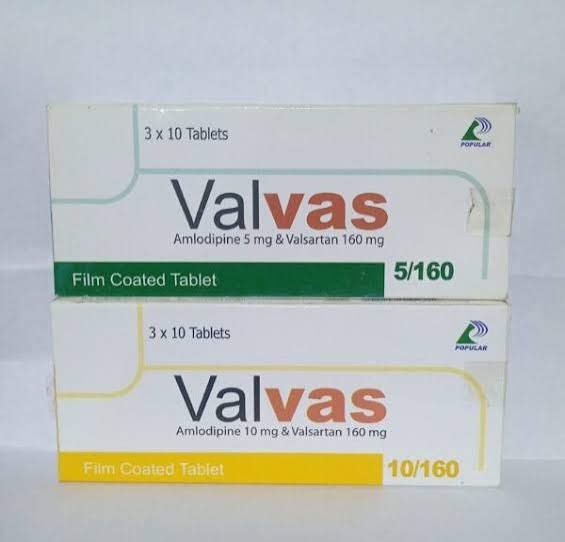
Valvas is a prescription cardiovascular medication formulated primarily to manage essential hypertension (high blood pressure). Produced in dual-combination formulations (e.g., Valvas) as well as triple-combination formulations (e.g., Valvas HCT), it utilizes complementary pharmacological pathways to deliver powerful, sustained, 24-hour blood pressure reduction.
Active Ingredients & Mechanisms of Action
Depending on the exact prescribed variant, Valvas combines two or three potent active components:
-
Valsartan (ARB): An Angiotensin II Receptor Blocker that selectively prevents angiotensin II from binding to $\text{AT}_1$ receptors in vascular smooth muscle and adrenal tissues. This blocks blood vessel constriction and reduces aldosterone secretion, leading to vascular relaxation and reduced sodium/water retention.
-
Amlodipine (CCB): A dihydropyridine Calcium Channel Blocker that inhibits the influx of extracellular calcium ions into arterial smooth muscle cells. This causes direct peripheral arterial vasodilation, reducing systemic vascular resistance.
-
Hydrochlorothiazide (Thiazide Diuretic — in Valvas HCT): Increases the renal excretion of sodium, chloride, and fluid, decreasing total plasma volume and cardiac workload.
Synergistic Effect: Combining these mechanisms targets different sites of blood pressure regulation. Additionally, the ARB component helps minimize peripheral ankle swelling typically associated with calcium channel blockers and offsets the potassium loss associated with thiazide diuretics.
Common Dosage Formulations & Strengths
Valvas is supplied in oral film-coated tablet form across several standard strength variations to support individual dosage titration:
-
Valvas (Dual Combination):
-
5 mg / 160 mg: 5 mg Amlodipine + 160 mg Valsartan
-
10 mg / 160 mg: 10 mg Amlodipine + 160 mg Valsartan
-
-
Valvas HCT (Triple Combination):
-
10 mg / 160 mg / 12.5 mg: 10 mg Amlodipine + 160 mg Valsartan + 12.5 mg Hydrochlorothiazide
-
10 mg / 160 mg / 25 mg: 10 mg Amlodipine + 160 mg Valsartan + 25 mg Hydrochlorothiazide
-
Clinical Indications
Valvas is indicated for:
-
Essential Hypertension: Treatment of high blood pressure in patients whose blood pressure is not adequately controlled on single-agent or dual-agent therapy, or as replacement therapy for patients already stable on the individual components.
-
Cardiovascular Risk Management: Lowering blood pressure to reduce the risk of major fatal and non-fatal cardiovascular events, including strokes and myocardial infarctions.
Key Pharmacokinetics
-
Absorption: Active ingredients are well-absorbed post-oral administration, reaching peak plasma levels within 2 to 4 hours (valsartan) and 6 to 12 hours (amlodipine).
-
Duration of Action: The long half-lives of amlodipine ($30\text{–}50\text{ hours}$) and valsartan allow for effective, once-daily blood pressure control over a 24-hour period.
-
Metabolism & Elimination: Valsartan is excreted primarily unchanged via bile and feces; amlodipine is extensively metabolized by the liver; hydrochlorothiazide is excreted unchanged in urine.
Administration Guidelines
-
Usage: Administered orally once daily, with or without food, ideally at the same time each day.
-
Titration: Full antihypertensive efficacy is typically reached within 2 weeks of starting or adjusting the dosage.
Safety Profile & Considerations
-
Common Side Effects: Dizziness, peripheral edema (ankle swelling), headache, fatigue, flushing, and mild electrolyte imbalances.
-
Boxed Warning (Fetal Toxicity): Drugs acting directly on the renin-angiotensin system (such as valsartan) can cause severe fetal injury and death. Discontinue immediately if pregnancy is detected.
-
Contraindications: Known hypersensitivity to amlodipine, valsartan, sulfonamides (for HCT formulations), or other dihydropyridine derivatives. Do not co-administer with aliskiren in patients with diabetes.
-
Key Interactions:
-
Potassium Supplements / Salt Substitutes: Risk of hyperkalemia.
-
Lithium: May increase serum lithium levels and toxicity.
-
NSAIDs: May diminish the blood pressure-lowering effect and increase the risk of severe renal impairment.
-
Note: Valvas is a prescription-only medication. Treatment and dose adjustments should strictly follow the guidance of a licensed healthcare professional.










Reviews
There are no reviews yet.