
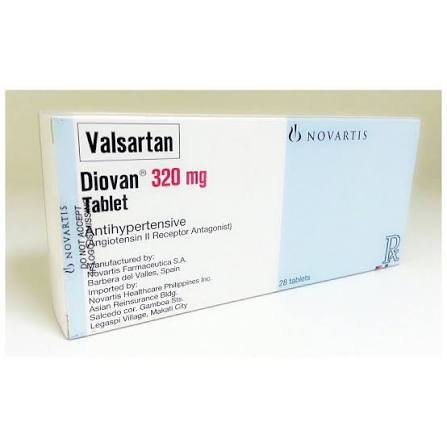
Valsartan (Diovan) is an innovator prescription medication developed by Novartis, belonging to the angiotensin II receptor blocker (ARB) class. Administered orally, it is widely used for treating hypertension, managing heart failure, and improving post-myocardial infarction outcomes. By selectively blocking the action of angiotensin II, Diovan promotes blood vessel relaxation and lowers systemic arterial pressure.
Active Ingredient & Mechanism of Action
-
Active Ingredient: Valsartan.
-
Mechanism: Valsartan selectively blocks the binding of angiotensin II to the $\text{AT}_1$ receptor in many tissues, including vascular smooth muscle and the adrenal gland:
-
Blood Pressure Control: By blocking the $\text{AT}_1$ receptor, it prevents angiotensin II–mediated vasoconstriction, leading to vasodilation, reduced peripheral vascular resistance, and lowered blood pressure.
-
Reduced Fluid Retention: Blocking the receptor prevents the release of aldosterone, helping reduce sodium and water retention.
-
Cardioprotection: By lowering total peripheral resistance and cardiac afterload, Diovan reduces stress on the heart muscle in patients with heart failure or left ventricular dysfunction following a heart attack.
-
Dosage Forms & Available Strengths
Diovan is available in oral tablet form across four standard strengths to support precise clinical dosing:
-
Diovan 40 mg Tablets: Starting dose for heart failure or post-myocardial infarction patients.
-
Diovan 80 mg Tablets: Standard starting dose for adult hypertension.
-
Diovan 160 mg Tablets: Standard maintenance dose for hypertension and target titration dose for heart failure and post-MI.
-
Diovan 320 mg Tablets: Maximum recommended daily dose for blood pressure control.
Clinical Indications
Diovan is FDA-approved and clinically indicated for:
-
Hypertension: Used as monotherapy or in combination with other antihypertensive agents (such as hydrochlorothiazide or amlodipine) to reduce blood pressure and lower the risk of stroke and heart attack.
-
Heart Failure (NYHA Class II–IV): Reduces hospitalizations for heart failure in patients who are intolerant to ACE inhibitors, or as an add-on therapy when ACE inhibitors cannot be used.
-
Post-Myocardial Infarction: Reduces cardiovascular mortality in clinically stable patients with left ventricular failure or left ventricular dysfunction following a heart attack.
Key Pharmacokinetics
-
Absorption: Rapidly absorbed following oral administration with peak plasma concentrations ($C_{max}$) reached within 2 to 4 hours. Bioavailability is approximately 25%.
-
Duration of Action: Features an elimination half-life of approximately 6 hours, but provides sustained 24-hour blood pressure reduction with once-daily dosing due to tight binding at the receptor level.
-
Metabolism & Elimination: Approximately 83% is excreted in feces and 13% in urine, mostly as unchanged drug. It is not extensively metabolized by cytochrome P450 enzymes.
Administration Guidelines
-
Usage: Administered orally once daily for hypertension (or twice daily for heart failure and post-MI protocols), with or without food.
-
Consistency: Should be taken at approximately the same time(s) each day.
-
Special Populations: Dose adjustments are generally not required for elderly patients or patients with mild-to-moderate renal or hepatic impairment.
Safety Profile & Considerations
-
Common Side Effects: Dizziness, hypotension (low blood pressure), fatigue, hyperkalemia (high potassium), and increased blood urea nitrogen (BUN).
-
Boxed Warning (Fetal Toxicity): Drugs acting on the renin-angiotensin system can cause injury and death to the developing fetus. Discontinue immediately if pregnancy is detected.
-
Contraindications: Known hypersensitivity to valsartan and concomitant use with aliskiren in patients with diabetes.
-
Key Interactions:
-
Potassium Supplements / Potassium-Sparing Diuretics: Increased risk of hyperkalemia.
-
NSAIDs: Co-administration may diminish the antihypertensive effect and increase the risk of severe renal function deterioration.
-
Lithium: May lead to increased serum lithium concentrations and toxicity.
-
Note: Diovan (Valsartan) is a prescription-only medication. Treatment, dose adjustments, and monitoring should strictly follow the guidance of a licensed healthcare professional.




Reviews
There are no reviews yet.