
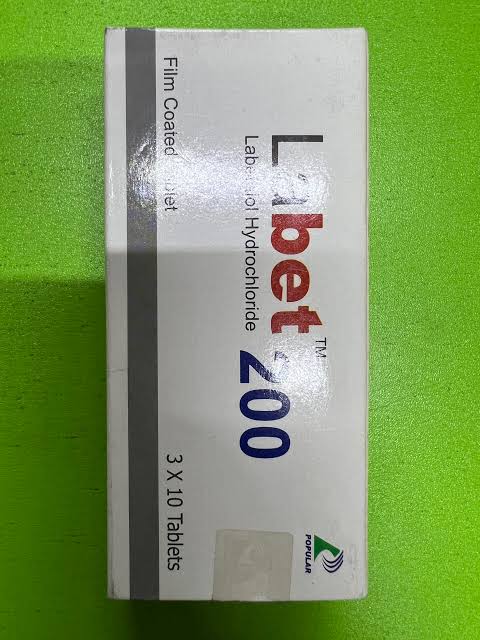
Labetalol is a widely prescribed cardiovascular medication classified as a non-selective alpha- and beta-adrenergic blocker. Administered orally or intravenously, it is used primarily to treat hypertension, particularly when rapid blood pressure control is needed or during pregnancy.
Active Ingredient & Mechanism of Action
-
Active Ingredient: Labetalol hydrochloride.
-
Dual-Action Mechanism: Labetalol combines selective $\alpha_1$-adrenergic blockade with non-selective $\beta_1$– and $\beta_2$-adrenergic blockade in a ratio of approximately 1:3 (oral) to 1:7 (IV):
-
$\alpha_1$-Blockade: Produces peripheral vasodilation, relaxing vascular smooth muscle and decreasing total peripheral resistance to lower blood pressure.
-
$\beta_1$-Blockade: Protects the heart from reflex tachycardia, reducing heart rate and myocardial oxygen demand without severely depressing cardiac output.
-
$\beta_2$-Blockade: Blocks beta-2 receptors in vascular and bronchial smooth muscle.
-
Available Strengths & Dosage Forms
Labetalol is supplied in both oral and parenteral formulations:
-
Oral Tablets: 100 mg, 200 mg, and 300 mg.
-
Intravenous (IV) Injection / Infusion: 5 mg/mL solution (commonly available in 20 mL, 40 mL, or pre-filled syringes) used in hospital or critical care settings.
Clinical Indications
Labetalol is indicated for:
-
Essential & Severe Hypertension: Management of chronic high blood pressure, often as add-on therapy.
-
Pregnancy-Induced Hypertension: A first-line therapeutic choice for managing gestational hypertension, preeclampsia, and eclampsia due to its favorable safety profile for both mother and fetus.
-
Hypertensive Emergencies: Used intravenously for rapid reduction of dangerously high blood pressure threatening target organ damage.
-
Acute Ischemic Stroke & Intracranial Hemorrhage: Off-label acute blood pressure control in neurocritical care settings.
Key Pharmacokinetics
-
Onset of Action: Oral administration takes effect within 20 to 120 minutes (peaking at 2–4 hours). Intravenous administration acts within 2 to 5 minutes, reaching peak effect in 5 to 15 minutes.
-
Half-Life: Elimination half-life ranges from 5.5 to 8 hours.
-
Metabolism & Elimination: Undergoes extensive first-pass metabolism in the liver into inactive metabolites; excreted primarily via the kidneys and secondarily in feces.
Administration Guidelines
-
Oral Usage: Typically administered twice daily (every 12 hours) with food to increase bioavailability and reduce GI upset.
-
Intravenous Usage: Given as slow IV bolus injections (e.g., 20 mg over 2 minutes, repeated every 10 minutes as needed) or as a continuous intravenous infusion under constant cardiac and blood pressure monitoring. Patients receiving IV labetalol should remain in a supine position to prevent orthostatic hypotension.
Safety Profile & Considerations
-
Common Side Effects: Dizziness, orthostatic hypotension, fatigue, nausea, nasal congestion, scalp tingling (a unique side effect associated with $\alpha$-blockade), and dyspnea.
-
Contraindications:
-
Asthma, severe COPD, or active bronchospasm (due to non-selective $\beta_2$-blockade).
-
Second- or third-degree heart block, severe bradycardia, or cardiogenic shock.
-
Uncompensated heart failure.
-
-
Precautions & Boxed Warnings:
-
Abrupt Discontinuation: Never stop labetalol abruptly; rapid withdrawal can cause severe rebound hypertension, angina, or myocardial infarction.
-
Hepatic Injury: Rare cases of severe, unpredictable liver damage have been reported; therapy should be discontinued immediately if jaundice or liver enzyme elevation occurs.
-
Masking Hypoglycemia: May mask tachycardia associated with low blood sugar in diabetic patients.
-
-
Key Interactions:
-
Nitroglycerin & Calcium Channel Blockers: Synergistic hypotensive and negative inotropic effects.
-
Cimetidine: Increases oral labetalol bioavailability.
-
Inhalational Anesthetics: May cause additive hypotensive effects.
-
Note: Labetalol is a prescription-only medication. Treatment, dosage titration, and monitoring must be managed under the direct supervision of a licensed healthcare professional.








Reviews
There are no reviews yet.