
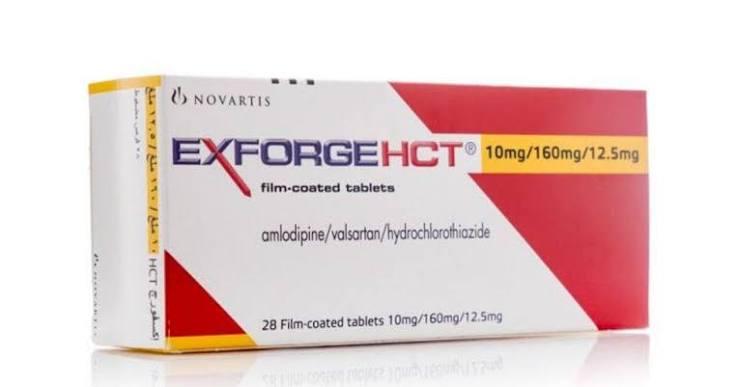
Exforge HCT is a prescription cardiovascular medication developed by Novartis that combines three distinct blood pressure-lowering agents into a single daily tablet: Amlodipine (a calcium channel blocker), Valsartan (an angiotensin II receptor blocker), and Hydrochlorothiazide (a thiazide diuretic).
It is specifically designed for complex or resistant hypertension where dual-agent therapies fail to bring blood pressure within target range.
Active Ingredients & Triple Mechanism of Action
Exforge HCT targets three distinct physiological pathways to provide comprehensive 24-hour blood pressure reduction:
-
Amlodipine Besylate (CCB): Inhibits the entry of calcium ions into arterial smooth muscle cells, causing direct relaxation and dilation of peripheral blood vessels and reducing systemic vascular resistance.
-
Valsartan (ARB): Blocks angiotensin II from binding to $\text{AT}_1$ receptors, preventing vasoconstriction and inhibiting aldosterone secretion. This reduces total fluid retention and promotes vascular relaxation.
-
Hydrochlorothiazide / HCTZ (Thiazide Diuretic): Promotes the excretion of sodium, chloride, and accompanying fluid through the kidneys, reducing overall intravascular fluid volume and cardiac workload.
Triple Synergy: The three mechanisms complement each other: HCTZ reduces fluid volume, amlodipine relaxes resistance vessels, and valsartan prevents the reflex activation of the renin-angiotensin system triggered by the diuretic while counteracting amlodipine-induced ankle swelling.
Dosage Forms & Available Strengths
Exforge HCT is supplied as oral film-coated tablets in five fixed-dose combination strengths (Amlodipine / Valsartan / Hydrochlorothiazide):
-
5 mg / 160 mg / 12.5 mg
-
10 mg / 160 mg / 12.5 mg
-
5 mg / 160 mg / 25 mg
-
10 mg / 160 mg / 25 mg
-
10 mg / 320 mg / 25 mg (maximum recommended strength)
Clinical Indications
Exforge HCT is indicated for:
-
Essential Hypertension: Second-line or step-up treatment for adult patients whose blood pressure is not adequately controlled on any two of the individual drug classes (CCB, ARB, and diuretic).
-
Replacement Therapy: Substitution for patients who are already stable on individual components or dual combinations plus a third individual agent.
Note: Exforge HCT is not indicated for the initial treatment of hypertension.
Key Pharmacokinetics
-
Absorption: All three active components are rapidly absorbed following oral administration. Peak plasma levels occur within 6–12 hours for amlodipine, 2–4 hours for valsartan, and 1–2 hours for hydrochlorothiazide.
-
Bioavailability & Food: Food intake slightly reduces the bioavailability of valsartan and HCTZ, but does not significantly alter overall clinical effectiveness.
-
Duration & Elimination: Provides full 24-hour therapeutic coverage with once-daily dosing. Amlodipine is hepatic-metabolized; valsartan is cleared via bile/feces; hydrochlorothiazide is excreted unchanged by the kidneys.
Administration Guidelines
-
Usage: Administered orally once daily with water, with or without food.
-
Consistency: Take at approximately the same time each day to maintain steady therapeutic drug levels.
-
Dose Limits: Titration up to the maximum dose of 10/320/25 mg daily may occur after 2 weeks of continuous treatment.
Safety Profile & Considerations
-
Common Side Effects: Peripheral edema (ankle swelling), dizziness, headache, fatigue, nausea, muscle spasms, and mild electrolyte disturbances (e.g., hypokalemia or hyperkalemia).
-
Boxed Warning (Fetal Toxicity): Drugs acting on the renin-angiotensin system can cause severe injury or death to a developing fetus. Discontinue immediately if pregnancy is detected.
-
Contraindications:
-
Anuria (inability to produce urine) or severe renal impairment.
-
Known hypersensitivity to amlodipine, valsartan, HCTZ, or other sulfonamide-derived drugs.
-
Concomitant use with aliskiren in patients with diabetes mellitus.
-
-
Key Interactions:
-
Potassium Supplements / Salt Substitutes: Risk of hyperkalemia (due to valsartan) or hypokalemia (due to HCTZ); serum potassium requires regular monitoring.
-
Lithium: Thiazide diuretics decrease renal clearance of lithium, greatly increasing the risk of lithium toxicity.
-
NSAIDs: May reduce blood pressure-lowering effects and elevate the risk of severe renal function deterioration.
-
Antidiabetic Medications: Dose adjustments for insulin or oral hypoglycemics may be needed due to HCTZ-induced glucose tolerance changes.
-
Note: Exforge HCT is a potent, prescription-only medication. Dosing, titration, and monitoring of kidney function and electrolytes must be managed under the supervision of a licensed healthcare professional.








Reviews
There are no reviews yet.