
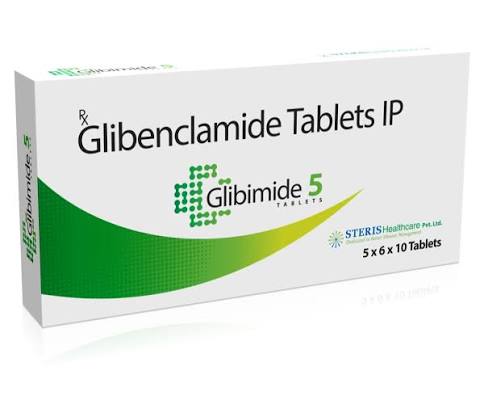
Glibenclamide (also known as glyburide in North America) is a potent, second-generation sulfonylurea oral antihyperglycemic medication used in the management of type 2 diabetes mellitus. It acts directly as an insulin secretagogue by binding selectively to ATP-sensitive potassium ($K_{\text{ATP}}$) channels (specifically the SUR1 subunit) on the plasma membrane of pancreatic beta cells.
This binding closes the potassium channels, causing cell depolarization, an influx of extracellular calcium ions through voltage-gated calcium channels, and subsequent exocytosis of pre-formed insulin storage granules into the bloodstream. Because glibenclamide relies on functioning pancreatic beta cells, it requires residual endogenous insulin secretion capacity to be clinically effective.
Primary Medical Indications
Glibenclamide is indicated as an oral therapy for adult patients with metabolic and endocrine conditions:
-
Type 2 Diabetes Mellitus: Used as an adjunct to diet and exercise to lower elevated blood glucose and reduce HbA1c levels when non-pharmacological lifestyle interventions alone are insufficient.
-
Monotherapy: For non-obese or obese type 2 diabetic patients where first-line agents like metformin are contraindicated or poorly tolerated.
-
Dual & Triple Combination Therapy: Combined with complementary oral antidiabetic agents (e.g., metformin, DPP-4 inhibitors, SGLT2 inhibitors) or basal insulin when single-agent therapy fails to achieve target glycemic control.
-
Neonatal Diabetes Mellitus (Off-Label / Orphan Use): Used off-label in specific genetic subtypes of neonatal diabetes caused by $K_{\text{ATP}}$ channel mutations (such as KCNJ11 or ABCC8 gene alterations).
Key Product Specifications & Dosing Forms
| Feature | Specification |
| Active Ingredient | Glibenclamide (Glyburide) |
| Pharmacological Class | Second-generation Sulfonylurea Antidiabetic |
| Available Formulations | Oral uncoated tablets, micronized oral tablets |
| Common Strengths | 1.25 mg, 2.5 mg, 5 mg tablets |
| Standard Dosage |
Initial: 2.5 mg to 5 mg orally once daily with breakfast or the first main meal. Titration: Increased incrementally by 2.5 mg at weekly intervals based on blood glucose response up to a maximum recommended dose of 15 mg to 20 mg daily (given in divided doses if $>10\text{ mg/day}$) |
| Administration | Must be swallowed whole with water immediately before or during breakfast/first main meal containing carbohydrates |
Critical Safety Guidelines & Precautions
-
High Risk of Prolonged Hypoglycemia: Glibenclamide has a relatively long duration of action and active metabolites that are cleared by the kidneys. Consequently, it carries a significantly higher risk of severe, prolonged, and life-threatening hypoglycemia compared to newer sulfonylureas (such as gliclazide or glimepiride).
-
Avoid in Elderly Patients: Due to decreased drug clearance and heightened vulnerability to hypoglycemia, glibenclamide is included in the BEERS criteria of potentially inappropriate medications for older adults (aged 65 and older).
-
Must Be Taken with Food: Patients must consume a substantial meal containing carbohydrates immediately after taking glibenclamide to prevent acute, precipitous drops in blood glucose.
-
Renal & Hepatic Impairment: Strictly contraindicated in severe renal impairment (eGFR less than 30 mL/min/1.73 $\text{m}^2$) and severe hepatic insufficiency due to marked accumulation of the active drug and increased risk of prolonged hypoglycemia.
-
G6PD Deficiency Warning: Treatment with sulfonylureas in patients with glucose-6-phosphate dehydrogenase (G6PD) deficiency can lead to acute hemolytic anemia; alternative non-sulfonylurea agents should be considered.
-
Contraindications: Strictly contraindicated in patients with type 1 diabetes, diabetic ketoacidosis (DKA), diabetic coma/pre-coma, or known hypersensitivity to sulfonylureas or sulfonamide derivatives.








Reviews
There are no reviews yet.