
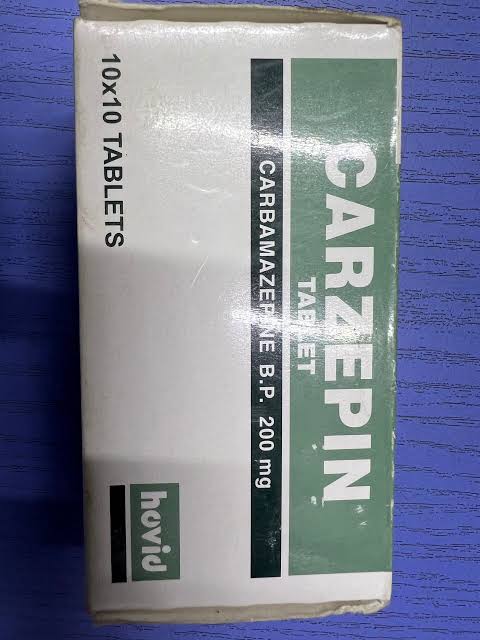
Carzepin is a brand name for Carbamazepine, an anticonvulsant and mood-stabilizing medication. It belongs to the iminostilbene class of drugs and is primarily used to control certain types of seizures, relieve specific severe nerve pain conditions, and manage psychiatric disorders.
Active Ingredient & Mechanism of Action
-
Active Ingredient: Carbamazepine.
-
Mechanism: Carbamazepine works by blocking voltage-gated sodium channels in neural membranes:
-
Neuronal Membrane Stabilization: By binding to inactivated sodium channels, it slows the recovery rate of these channels, preventing high-frequency, repetitive firing of action potentials.
-
Reduction of Synaptic Transmission: This dampens hyper-excitable brain signals and decreases synaptic transmission, controlling seizure activity and blunting chronic nerve pain signaling.
-
Dosage Forms & Available Strengths
Carzepin is commonly supplied in oral dosage forms:
-
Standard Tablets: 200 mg tablets.
-
Controlled-Release / Sustained-Release Tablets: 200 mg and 400 mg formulation options designed to provide stable blood levels and reduce daily peak-to-trough fluctuations.
-
Oral Liquid / Suspension: Formulations (e.g., 100 mg / 5 mL) for children or adults who cannot swallow solid tablets.
Clinical Indications
Carzepin is indicated for:
-
Epilepsy & Seizures: First-line treatment for focal (partial) seizures and generalized tonic-clonic seizures. (Note: It can exacerbate absence or myoclonic seizures).
-
Neuropathic Pain: First-line treatment for Trigeminal Neuralgia (severe facial nerve pain) and Glossopharyngeal Neuralgia.
-
Bipolar Disorder: Treatment of acute mania and long-term maintenance therapy for bipolar I disorder in patients who do not respond to or cannot tolerate lithium.
Key Pharmacokinetics
-
Absorption: Absorbed relatively slowly and variable from the gastrointestinal tract.
-
Metabolism & Auto-Induction: Metabolized in the liver primarily by the CYP3A4 enzyme into its active metabolite, carbamazepine-10,11-epoxide. Carbamazepine is a potent auto-inducer—it induces its own hepatic metabolism over the first 2 to 4 weeks of therapy, decreasing its own serum half-life.
-
Protein Binding: Highly bound to plasma proteins ($\sim 75\text{–}90\%$).
Administration Guidelines
-
Food Interaction: Should be taken with or after food to minimize gastrointestinal upset.
-
Consistent Schedule: Taken at evenly spaced intervals throughout the day to maintain steady blood plasma concentrations. Controlled-release forms should be swallowed whole and not crushed or chewed.
-
Gradual Titration: Doses are started low and gradually increased over several weeks under medical guidance until optimal control is achieved.
Safety Profile & Considerations
-
Boxed Warnings & Major Safety Risks:
-
Severe Skin Reactions: Can cause life-threatening cutaneous reactions like Stevens-Johnson Syndrome (SJS) and Toxic Epidermal Necrolysis (TEN). Patients of Asian ancestry carrying the HLA-B*1502 genetic allele have a significantly higher risk and should be screened prior to starting therapy.
-
Aplastic Anemia & Agranulocytosis: Risk of dangerous blood dyscrasias (severe drops in white blood cells or red blood cells). Baseline and periodic complete blood counts (CBC) are required.
-
-
Common Side Effects: Dizziness, drowsiness, unsteadiness (ataxia), nausea, vomiting, double vision (diplopia), and hyponatremia (low blood sodium levels due to fluid retention).
-
Pregnancy Warning: Carbamazepine is a known teratogen (associated with neural tube defects like spina bifida and developmental delays). It should be avoided during pregnancy unless no alternative exists.
-
Never Stop Abruptly: Discontinuing Carzepin suddenly can trigger rebound seizures or status epilepticus.
-
Potent Hepatic Enzyme Inducer (Drug Interactions): Induces CYP3A4, CYP1A2, CYP2C9, and P-glycoprotein. It dramatically reduces the effectiveness of:
-
Oral Contraceptives: Renders hormonal birth control unreliable; barrier methods are required.
-
Anticoagulants (e.g., Warfarin): Lowers blood-thinning effects.
-
Antiretrovirals, Anticonvulsants, & Antipsychotics: Decreases therapeutic blood levels of concurrent medications.
-
-
Grapefruit Juice Warning: Grapefruit juice inhibits CYP3A4 and can significantly raise Carzepin levels to toxic ranges.
Note: Carzepin is a narrow-therapeutic-index prescription medication. Therapeutic blood level monitoring, routine blood work (CBC, liver enzymes, and electrolytes), and careful dose adjustments must be managed directly under the supervision of a neurologist or qualified healthcare provider.








Reviews
There are no reviews yet.