
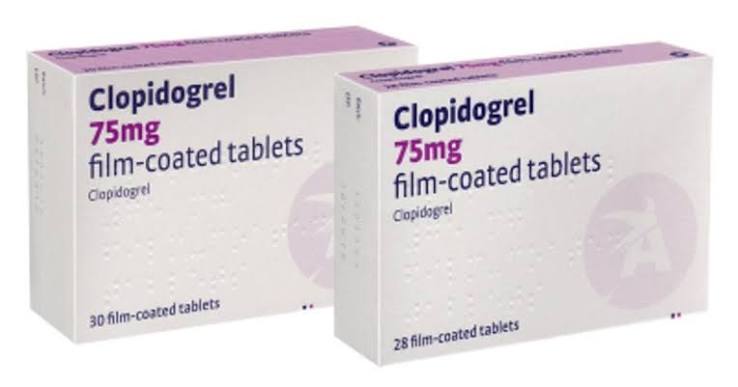
Clopidogrel (commonly marketed under the brand name Plavix) is an oral antiplatelet agent belonging to the thienopyridine class. It works by preventing blood platelets from sticking together, reducing the risk of harmful blood clot formation (thrombus) in arteries.
Active Ingredient & Mechanism of Action
-
Active Ingredient: Clopidogrel bisulfate.
-
Mechanism: Clopidogrel is an irreversible $P2Y_{12}$ ADP receptor antagonist:
-
Prodrug Activation: It is an inactive prodrug that requires bioactivation by hepatic cytochrome P450 enzymes.
-
Receptor Blockade: Its active metabolite irreversibly binds to the adenosine diphosphate ($ADP$) $P2Y_{12}$ receptors on platelet surfaces.
-
Inhibition of Aggregation: This prevents ADP-mediated activation of the $GPIIb/IIIa$ complex, permanently inhibiting platelet activation and aggregation for the remainder of the platelet’s lifespan ($\sim 7\text{–}10\text{ days}$).
-
Dosage Forms & Available Strengths
-
Oral Tablets: Standard 75 mg maintenance tablets and 300 mg loading dose tablets.
-
Combination Formulations: Co-formulated with low-dose aspirin in some regions (e.g., Co-Plavix 75 mg clopidogrel / 100 mg aspirin).
Clinical Indications
Clopidogrel is indicated for the prevention of atherothrombotic events in:
-
Acute Coronary Syndrome (ACS):
-
Unstable angina or non–ST-elevation myocardial infarction (NSTEMI).
-
ST-elevation myocardial infarction (STEMI).
-
-
Recent Myocardial Infarction (Heart Attack) or Recent Ischemic Stroke.
-
Established Peripheral Artery Disease (PAD).
-
Stent Thrombosis Prevention: Used following Percutaneous Coronary Intervention (PCI) with cardiac stent placement, typically as Dual Antiplatelet Therapy (DAPT) combined with aspirin.
Key Pharmacokinetics & Pharmacogenomics
-
Absorption: Well absorbed orally, but only a small fraction is converted into the active metabolite.
-
Hepatic Bioactivation: Converted in a two-step hepatic enzymatic process into its active thiol metabolite. The CYP2C19 enzyme plays a key role in this activation.
-
Boxed Warning — Reduced Efficacy in CYP2C19 Poor Metabolizers:
-
Individuals carrying loss-of-function CYP2C19 genetic alleles (poor metabolizers) produce lower levels of the active drug.
-
This leads to reduced antiplatelet effects and a higher rate of cardiovascular events/stent thrombosis. Alternative $P2Y_{12}$ inhibitors (such as prasugrel or ticagrelor) may be indicated.
-
-
Elimination: Excreted roughly equally in urine ($\sim 50\%$) and feces ($\sim 46\%$).
Administration Guidelines & Dosing Limits
-
Administration: Taken once daily with or without food.
-
Maintenance Dosing: Standard adult dosage is 75 mg once daily.
-
Loading Dose: For acute coronary syndromes or pre-PCI, a single 300 mg or 600 mg loading dose is typically given to achieve rapid platelet inhibition.
-
Surgical Discontinuation: Because platelet binding is irreversible, clopidogrel should usually be discontinued 5 to 7 days before elective major surgery to reduce the risk of excessive perioperative bleeding.
Safety Profile & Critical Warnings
-
Bleeding Risk: Increased risk of serious or fatal bleeding (including gastrointestinal bleeding and intracranial hemorrhage).
-
Common Side Effects: Easy bruising, nosebleeds (epistaxis), minor bleeding from cuts, hematoma formation, and dyspepsia (indigestion).
-
Serious Safety Risks:
-
Thrombotic Thrombocytopenic Purpura (TTP): A rare, potentially fatal blood disorder characterized by low platelets and microvascular clotting, requiring urgent plasma exchange.
-
-
Contraindications: Active pathological bleeding (e.g., active peptic ulcer or intracranial hemorrhage) and severe hepatic impairment.
-
Key Drug Interactions:
-
Proton Pump Inhibitors (e.g., Omeprazole, Esomeprazole): Potent CYP2C19 inhibitors that significantly lower clopidogrel’s bioactivation and therapeutic effect. Pantoprazole is generally preferred if a PPI is clinically necessary.
-
Anticoagulants & NSAIDs: Co-administration with warfarin, DOACs, aspirin, or chronic NSAIDs (ibuprofen, diclofenac) dramatically elevates major bleeding risks.
-
Note: Clopidogrel is a prescription-only antiplatelet medication. Treatment duration (especially following stent placement), conversion to other antiplatelet agents, and perioperative management must be directed by a cardiologist or attending physician.









Reviews
There are no reviews yet.