
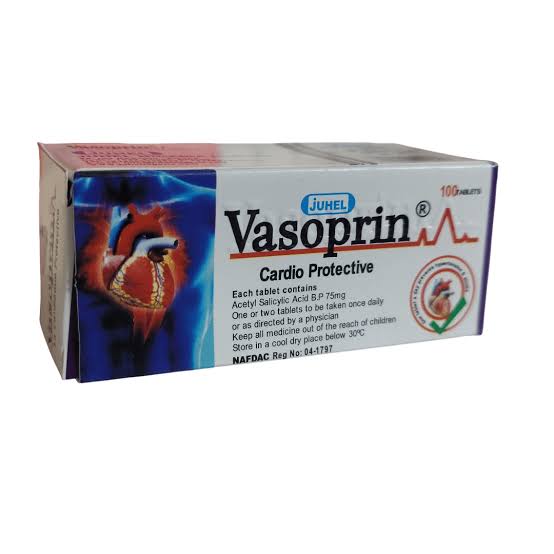
Low-dose Aspirin (also known as Acetylsalicylic Acid or ASA, marketed under cardio-protective brand names such as Vasoprin, Bayer Low Dose, and Ecotrin) is an oral antiplatelet agent. At low doses (typically 75 mg to 100 mg daily), it works primarily as a blood thinner to prevent the formation of blood clots in arteries, lowering the risk of heart attacks and ischemic strokes.
Active Ingredient & Cardio-Protective Mechanism
-
Active Ingredient: Acetylsalicylic Acid (ASA).
-
Mechanism of Action: Low-dose aspirin irreversibly inhibits the cyclooxygenase-1 (COX-1) enzyme inside blood platelets:
-
Blockade of Thromboxane $A_2$: COX-1 inhibition prevents platelets from synthesizing Thromboxane $A_2$ ($TXA_2$), a potent chemical signal that promotes platelet aggregation and arterial vasoconstriction.
-
Irreversible Effect: Because platelets lack cell nuclei, they cannot synthesize new COX-1 enzymes. The antiplatelet effect persists for the entire life of the platelet ($\sim 7\text{–}10\text{ days}$).
-
Low-Dose Selectivity: At low doses (75–100 mg), aspirin selectively targets platelet COX-1 while sparing endothelial COX-2, maintaining the production of prostacyclin ($PGI_2$), a natural vasodilator and inhibitor of platelet aggregation. (Higher doses $\ge 325\text{ mg}$ exert systemic anti-inflammatory and analgesic effects but lose this specific enzymatic selectivity).
-
Dosage Forms & Formulations
Cardio-protective aspirin is produced in low-strength oral formulations designed for long-term daily adherence:
-
Enteric-Coated (Safety-Coated) Tablets: 75 mg, 81 mg, and 100 mg tablets. The special coating resists stomach acid and dissolves in the higher pH environment of the small intestine, helping to protect the stomach lining from direct topical irritation.
-
Chewable Tablets: 81 mg chewable tablets (often used for immediate absorption during suspected acute cardiac events).
-
Standard / Non-Coated Tablets: 75 mg to 100 mg standard oral tablets.
Clinical Indications
Low-dose aspirin is prescribed across cardiovascular and cerebrovascular settings:
-
Secondary Prevention (Established Cardiovascular Disease):
-
Prevention of recurrent myocardial infarction (heart attack) or recurrent ischemic stroke / transient ischemic attack (TIA).
-
Prevention of atherothrombotic events in patients with stable angina, unstable angina, or peripheral artery disease (PAD).
-
Prevention of blood clot formation following coronary artery bypass grafting (CABG) or cardiac stent placement (often combined with $P2Y_{12}$ inhibitors like clopidogrel as Dual Antiplatelet Therapy / DAPT).
-
-
Acute Coronary Syndrome (ACS) Management: Given immediately upon suspecting an acute heart attack (a chewed 162 mg to 325 mg dose for rapid absorption).
-
Obstetric Indication (Preeclampsia Prevention): Administered to high-risk pregnant women starting in early pregnancy to prevent preeclampsia.
-
Primary Prevention (Selective Use): Historically used broadly, current guidelines restrict routine low-dose aspirin for primary prevention (in people without known heart disease) to select high-cardiovascular-risk adults due to the risk of internal bleeding outweighing benefit.
Key Pharmacokinetics
-
Absorption: Rapidly absorbed from the stomach and upper small intestine. Standard tablets achieve significant platelet inhibition within 30 to 60 minutes; chewable aspirin acts faster. Enteric-coated tablets delay absorption by several hours.
-
Metabolism: Rapidly hydrolyzed by plasma and liver esterases to its primary active metabolite, salicylate.
-
Elimination: Salicylate is metabolized in the liver and excreted via the kidneys in urine. Plasma half-life of unhydrolyzed aspirin is very short ($\sim 15\text{–}20\text{ minutes}$), but its functional antiplatelet effect lasts up to 10 days.
Administration Guidelines
-
How to Take: Take once daily with food or water to minimize stomach upset.
-
Enteric-Coated Tablets: Swallow whole with water—do not crush, split, or chew enteric-coated tablets for daily maintenance, as breaking the coating causes direct gastric mucosal exposure.
-
Acute Heart Attack Exception: If taking aspirin during an acute suspected heart attack, a non-coated or chewable tablet should be chewed and swallowed immediately to ensure rapid absorption.
-
Surgical Considerations: Must often be held 5 to 7 days prior to major elective surgeries or invasive dental procedures to limit excessive perioperative bleeding, strictly as directed by the surgeon or cardiologist.
Safety Profile & Critical Warnings
-
Gastrointestinal Risk: Can cause gastric irritation, heartburn, nausea, gastric mucosal erosion, peptic ulcers, and upper gastrointestinal bleeding.
-
Major Bleeding Risk: Increases overall bleeding tendency, leading to easy bruising, nosebleeds, hematomas, and prolonged bleeding from cuts. Rare but severe risks include major GI hemorrhage and hemorrhagic stroke.
-
Aspirin-Exacerbated Respiratory Disease (AERD): Can trigger severe bronchospasm, facial swelling, or asthma attacks in individuals with NSAID-sensitive asthma or nasal polyps.
-
Reye’s Syndrome Warning: Contraindicated in children and teenagers with viral illnesses (such as chickenpox or influenza) due to the risk of Reye’s syndrome—a severe, potentially fatal condition causing acute brain and liver swelling.
-
Key Drug Interactions:
-
Other Blood Thinners (e.g., Clopidogrel, Warfarin, DOACs): Greatly elevates major bleeding risks; combined use requires careful specialist supervision.
-
NSAIDs (e.g., Ibuprofen, Naproxen): Concomitant ibuprofen can competitively block aspirin’s access to the COX-1 binding site, reducing its cardio-protective effectiveness. Ibuprofen should be taken at least 8 hours before or 30 minutes after low-dose aspirin.
-
Alcohol: Daily alcohol consumption alongside low-dose aspirin significantly increases the risk of stomach bleeding.
-
Note: Low-dose cardio-protective aspirin is a specialized antiplatelet regimen. Long-term daily initiation, secondary prevention management, and risk assessments for gastrointestinal or systemic bleeding should be evaluated in consultation with a physician or cardiologist.




Reviews
There are no reviews yet.