
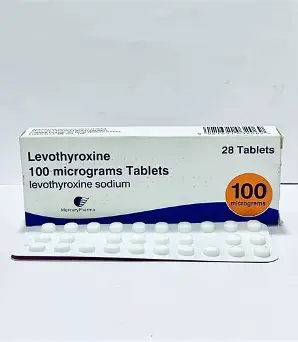
Levothyroxine (commonly marketed under brand names such as Synthroid, Euthyrox, and Levoxyl) is a synthetic form of the endogenous thyroid hormone thyroxine ($T_4$). It is used as replacement therapy for patients with inadequate natural thyroid hormone production.
Active Ingredient & Mechanism of Action
-
Active Ingredient: Levothyroxine Sodium ($L\text{-thyroxine}$ or synthetic $T_4$).
-
Mechanism: Levothyroxine acts identical to endogenous thyroxine:
-
Conversion to Active $T_3$: Once in systemic circulation, $T_4$ is converted in peripheral tissues (liver, kidneys, brain) by deiodinase enzymes into triiodothyronine ($T_3$), the biologically active thyroid hormone.
-
Metabolic Regulation: $T_3$ binds to nuclear thyroid hormone receptors, regulating gene expression to control basal metabolic rate, protein synthesis, body temperature, heart rate, and carbohydrate/fat metabolism.
-
Dosage Forms & Available Strengths
Levothyroxine is a narrow-therapeutic-index drug, meaning precise dosing is critical. It is produced in a wide variety of microgram ($\text{mcg}$) strengths:
-
Oral Tablets: Formulated in precise microgram increments (e.g., 25 mcg, 50 mcg, 75 mcg, 88 mcg, 100 mcg, 112 mcg, 125 mcg, 137 mcg, 150 mcg, 175 mcg, 200 mcg, and 300 mcg).
-
Oral Solutions / Liquid Capsules (e.g., Tirosint): Formulated for patients with malabsorption disorders or difficulty swallowing solid tablets.
-
Injectable Powder / Solution: Vials used in emergency clinical settings for severe acute thyroid deficiency (myxedema coma).
Clinical Indications
-
Hypothyroidism: Replacement or supplemental therapy for primary (thyroid gland dysfunction), secondary (pituitary gland failure), or tertiary (hypothalamic deficiency) hypothyroidism—including cases caused by Hashimoto’s thyroiditis, surgical removal of the thyroid, or radiation therapy.
-
Pituitary TSH Suppression: Used in the management and suppression of thyroid-stimulating hormone (TSH) in patients with differentiated thyroid cancer or thyroid nodules/goiters.
Key Pharmacokinetics
-
Absorption: Variably absorbed from the gastrointestinal tract (primarily the jejunum and ileum), with bioavailability ranging from 40% to 80%. Absorption is significantly impaired by food and certain minerals.
-
Protein Binding: Highly bound to plasma proteins ($> 99\%$), mainly thyroid-binding globulin (TBG), transthyretin, and albumin.
-
Half-Life: Exceptionally long elimination half-life of approximately 6 to 7 days in patients with normal thyroid function (extended up to 9–10 days in hypothyroid states). Because of this long half-life, it takes 4 to 6 weeks to reach steady-state plasma concentrations after initiating therapy or changing doses.
-
Metabolism & Elimination: Metabolized primarily in the liver and peripheral tissues via deiodination. Excreted mainly in urine with a portion eliminated in feces.
Administration Guidelines
-
Strict Empty Stomach Requirement: Must be taken once daily in the morning on an empty stomach, at least 30 to 60 minutes before breakfast or morning beverages (other than plain water). Alternatively, it can be taken at bedtime at least 3 to 4 hours after the last meal.
-
Avoid Co-Administration with Binding Agents: Wait at least 4 hours before or after taking supplements containing calcium, iron, aluminum, magnesium (antacids), or bile acid sequestrants, as they bind to levothyroxine in the gut and block its absorption.
-
Brand Consistency: Due to minor variations in bioavailability between different generic and brand manufacturers, patients should ideally remain on the same manufacturer’s formulation.
Safety Profile & Considerations
-
Boxed Warning (Not for Weight Loss): Thyroid hormones, including levothyroxine, should never be used for weight loss or obesity management. In euthyroid individuals, therapeutic doses are ineffective for weight loss, and large doses can cause severe, life-threatening toxicity.
-
Side Effects (Symptoms of Hyperthyroidism / Over-replacement):
-
Cardiovascular: Palpitations, tachycardia (rapid heart rate), chest pain, or elevated blood pressure.
-
Central Nervous System: Restlessness, anxiety, tremors, insomnia, heat intolerance, and excessive sweating.
-
Gastrointestinal & Metabolic: Weight loss, increased appetite, diarrhea, and menstrual irregularities.
-
-
Special Populations:
-
Elderly & Cardiovascular Patients: Must start at lower doses (e.g., 12.5 to 25 mcg/day) to avoid precipitating myocardial ischemia, arrhythmias, or angina.
-
Pregnancy: Levothyroxine requirements usually increase during pregnancy. Regular TSH monitoring is necessary to adjust doses and ensure optimal fetal neurological development.
-
-
Key Drug Interactions:
-
Estrogen / Oral Contraceptives: Increase TBG levels, potentially requiring an increased levothyroxine dose.
-
Blood Thinners (e.g., Warfarin): Levothyroxine can enhance the activity of oral anticoagulants, increasing bleeding risk.
-
Antidiabetics: May require adjustments to insulin or oral hypoglycemics as thyroid status normalizes.
-
Note: Levothyroxine is a prescription-only narrow-therapeutic-index medication. Dosage titration must be guided by periodic Thyroid-Stimulating Hormone (TSH) and free $T_4$ blood tests supervised by a healthcare provider.









Reviews
There are no reviews yet.