
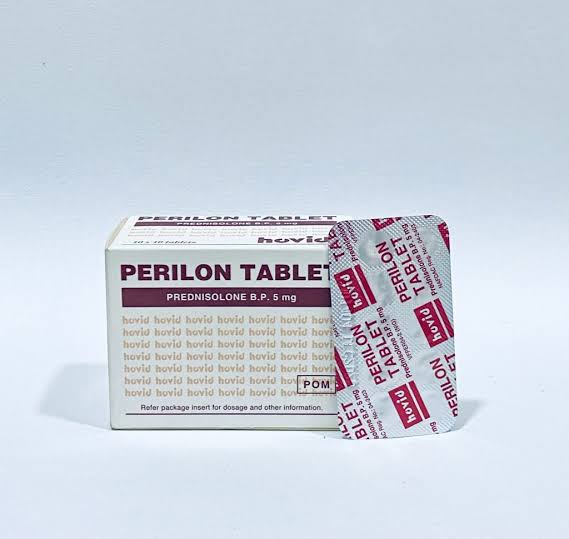
Perilon is a brand name for the systemic corticosteroid Prednisone (or its active metabolite, Prednisolone). It works as a potent anti-inflammatory and immunosuppressive agent, helping to calm down overactive immune responses and reduce swelling, pain, and redness across various body systems.
Active Ingredient & Mechanism of Action
-
Active Ingredient: Prednisone / Prednisolone.
-
Mechanism: Prednisone is converted by the liver into prednisolone, which binds to intracellular glucocorticoid receptors. This action suppresses inflammatory signaling molecules (prostaglandins, leukotrienes, cytokines) and decreases immune cell migration, blunting the body’s inflammatory and allergic responses.
Dosage Forms & Available Strengths
Perilon is primarily supplied as oral solid dosage forms:
-
Oral Tablets: Commonly available in 5 mg strength (often packaged in blister packs of 100 tablets).
Clinical Indications
Perilon is prescribed for a wide range of acute and chronic conditions:
-
Allergic Reactions: Severe asthma flares, allergic rhinitis, drug hypersensitivity, and contact dermatitis.
-
Rheumatoid & Autoimmune Conditions: Rheumatoid arthritis, systemic lupus erythematosus (SLE), and polymyalgia rheumatica.
-
Inflammatory Skin Diseases: Psoriasis, severe eczema, and pemphigus.
-
Gastrointestinal Disorders: Flare-ups of ulcerative colitis and Crohn’s disease.
-
Renal & Endocrine Conditions: Nephrotic syndrome and adrenal insufficiency (as replacement therapy).
Key Pharmacokinetics
-
Absorption: Rapidly and almost completely absorbed from the gastrointestinal tract following oral intake.
-
Metabolism: Prednisone is quickly converted in the liver by the enzyme 11$\beta$-HSD1 into active prednisolone.
-
Elimination & Half-Life: Plasma half-life is approximately 2 to 4 hours, though its biological/anti-inflammatory effect lasts much longer (18 to 36 hours). Metabolites are excreted mainly through the kidneys in urine.
Administration Guidelines
-
Food Interaction: Should be taken with or immediately after food or milk to prevent stomach irritation and gastrointestinal distress.
-
Timing: When taken as a single daily dose, it is typically taken in the morning (around 8 AM) to mimic the body’s natural diurnal cortisol rhythm and reduce insomnia.
-
Crucial Rule — Never Stop Abruptly: Long-term or high-dose therapy suppresses the body’s natural adrenal hormone production. Stopping Perilon suddenly can trigger a life-threatening adrenal crisis. The dose must be gradually tapered down under a physician’s supervision.
Safety Profile & Considerations
-
Short-Term Side Effects: Increased appetite, weight gain, fluid retention (swelling/puffiness), mood swings, insomnia, and mild elevation in blood pressure or blood sugar.
-
Long-Term / High-Dose Risks:
-
Immune Suppression: Increased vulnerability to viral, bacterial, and fungal infections.
-
Bone Density Loss: Osteoporosis and heightened fracture risk.
-
Endocrine & Metabolic: Cushingoid features (“moon face”, central weight gain), hyperglycemia/steroid-induced diabetes, and growth suppression in children.
-
Gastrointestinal: Risk of peptic ulcers or GI bleeding, especially if combined with NSAIDs (e.g., ibuprofen, diclofenac).
-
-
Pregnancy & Lactation: Crosses the placenta; long-term use requires careful benefit-vs-risk assessment by an obstetrician.
-
Key Drug Interactions:
-
NSAIDs & Aspirin: Greatly increases the risk of stomach ulcers and GI bleeding.
-
Antidiabetics: Reduces insulin/oral hypoglycemic effectiveness, raising blood sugar.
-
Live Vaccines: Should be avoided during immunosuppressive steroid therapy.
-
Note: Perilon is a potent prescription corticosteroid. Dosing schedules, tapering protocols, and safety monitoring must be managed directly by a qualified healthcare professional.








Reviews
There are no reviews yet.